Bottled Feelings: Why Gen Z Is Using Scent to Archive the Moments That Matter Most
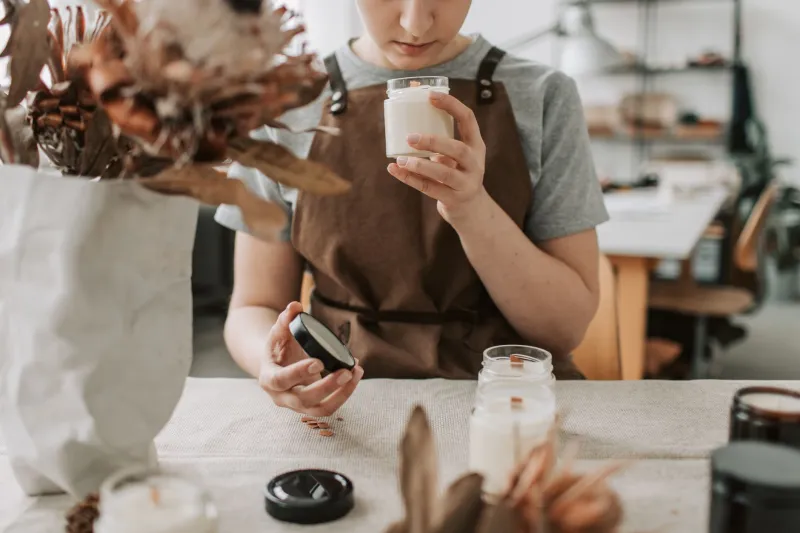
Ashley Tran still owns the candle she'll never burn.
She bought it on a whim at a small market in Portland three years ago, right around the time her best friend was moving across the country. Cedar, black tea, and something vaguely like old books. They lit it on the last night they shared an apartment, split a bottle of wine on the floor surrounded by half-packed boxes, and talked until 3 a.m. Now the candle lives on Ashley's nightstand — barely used, mostly just there — and on the hardest nights, she takes the lid off and breathes.
"I can't explain it rationally," she says. "But that smell is her. That smell is that whole chapter of my life. No photo does what that does."
Ashley is 26, and she is very much not alone.
The New Memory Keeper Doesn't Have a Screen
Across the country, young Americans are quietly building what some are calling "scent archives" — intentional collections of candles, perfumes, colognes, and even room sprays that function less like beauty products and more like emotional artifacts. It's not about smelling good. It's about remembering — and feeling — with a precision that photos and playlists simply can't match.
The numbers back this up. The global fragrance market is booming, and Gen Z is driving a significant chunk of that growth in the US, particularly in the niche and indie fragrance space. Small-batch candle brands, artisan perfumers, and even DIY fragrance kits have exploded in popularity on TikTok and Instagram, where #scentmemory and #fragrancewardrobe have racked up millions of views. But scroll past the aesthetics and the unboxings, and you'll find something more personal: people talking about why a particular scent matters, not just what it smells like.
For many, it started with a moment of accidental recognition — catching a whiff of sunscreen and suddenly being seven years old at the Jersey Shore again, or smelling a stranger's cologne on the subway and feeling an almost violent wave of grief for someone they loved. That involuntary power is exactly what drew them in.
Why Your Nose Hits Different
This isn't just poetic. There's real neuroscience behind it.
Dr. Rachel Herz, a cognitive neuroscientist and one of the leading researchers on olfactory memory in the US, has spent years studying why smell triggers emotional memory so differently than sight or sound. The short version: smell is the only sense with a direct line to the amygdala and hippocampus — the parts of the brain that process emotion and memory. Every other sense gets filtered through the thalamus first, essentially passing through a kind of logical checkpoint. Smell skips that entirely.
"When you smell something, you're not thinking about the memory," Herz explains. "You're in it. The emotional response comes before any conscious recognition. That's why it feels so overwhelming — because it is."
This is why the smell of your grandmother's house doesn't just remind you of her. It makes you miss her in your chest before your brain has even finished identifying what you're smelling. Gen Z, it turns out, has figured out how to weaponize this for their own emotional lives — intentionally rather than accidentally.
Building a Scent Wardrobe With Purpose
Marcos Rivera, 24, started his fragrance collection during the pandemic and now owns somewhere around thirty bottles. But he's quick to explain that it's not a hobby in the traditional sense — it's more like a filing system.
"There's one cologne I wore every day of my first real job. I don't wear it anymore, but I keep it. Sometimes I spray it on a piece of paper just to check in with that version of myself," he says. "There's another one I associate entirely with my college roommate — he wore it constantly, and now whenever I smell it in the wild, I feel this warmth. I found a dupe of it and bought it just to have that feeling accessible."
This practice of intentional association — wearing or burning a specific scent during a meaningful experience in order to lock it in — is something fragrance enthusiasts talk about constantly online. It's a kind of olfactory journaling. You're not just living the moment; you're giving it a sensory anchor you can return to.
Some people do this with new relationships — wearing a specific perfume only with a particular person so that scent becomes permanently coded to them. Others use it for solo milestones: a new city, a solo trip, a hard year survived. The candle burned through a breakup. The perfume bought to mark a graduation.
"I think we're the generation that grew up with our photos already backed up to the cloud," says Jess Kim, 27, a fragrance blogger based in Chicago. "We have thousands of images we never look at. But a smell? You can't scroll past it. It just gets you."
The Indie Fragrance World Is Listening
Small fragrance brands have noticed the shift and are leaning in hard. Labels like Imaginary Authors, D.S. & Durga, and Boy Smells have built entire identities around narrative-driven scents — fragrances with names like The Cobra & The Canary or Woodcut that are explicitly designed to evoke a story, a place, a feeling. Their marketing doesn't talk about notes and accords the way traditional perfumery does. It talks about moments.
And then there's the DIY wave. Candle-making kits, blending workshops, and custom fragrance studios (where you can essentially build your own scent from scratch) have multiplied across major US cities. At these studios, the most common request isn't "something that smells luxurious." It's "something that smells like my mom's house" or "something that feels like summer camp in Vermont."
The goal isn't novelty. It's reconstruction.
More Than Nostalgia
What makes this trend genuinely interesting — and genuinely moving — is that it's not purely backward-looking. Yes, people are using scent to preserve the past. But they're also using it to build the future.
Ashley, the woman with the never-burned candle, recently started a new ritual: every time she enters a significant new chapter, she buys a scent to mark it. A new apartment. A new relationship. A new job that actually feels right. She wears it or burns it consistently throughout that period, consciously anchoring the experience.
"When it's over — whether it ends well or badly — I have something to hold," she says. "I'm not just hoping I remember. I'm making sure I do."
There's something quietly profound about that. In a world where we are all taking more photos than we'll ever look at and saving more songs than we'll ever hear again, here is a generation choosing to archive their lives through something slower, more visceral, and entirely impossible to scroll past.
You can't fast-forward through a smell. You can't mute it. It just finds you — and pulls you straight back to the exact moment you were trying to hold onto.
Maybe that's the whole point.