Beautifully Broken: Why We've Fallen Hard for Stories That Don't Have It Together
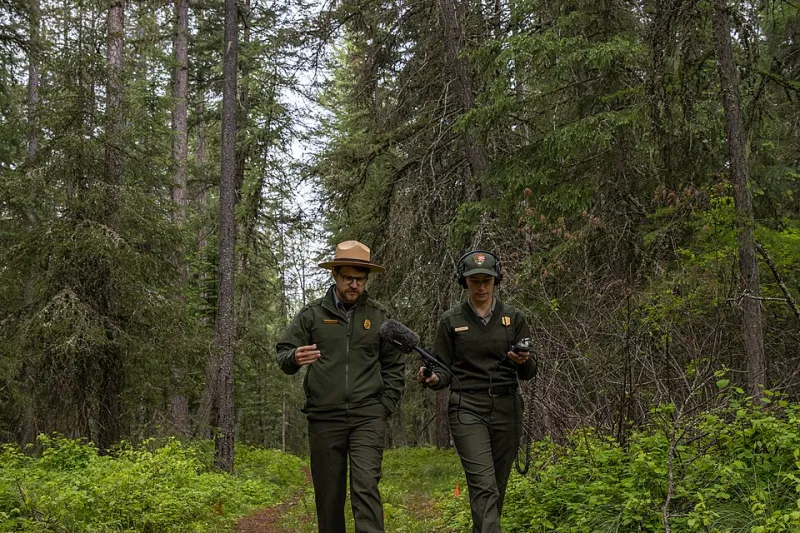
Photo: GlacierNPS, Public domain, via Wikimedia Commons
Let me tell you about a podcast episode that wrecked me on a Tuesday afternoon.
It wasn't produced by a major network. There was no dramatic score swelling at the emotional moments. The host stumbled over a sentence twice and just kept going. At one point, you could hear what sounded like a dog walking across a hardwood floor. And for about forty minutes, a woman talked about the year her marriage fell apart in a way that felt so specific and so unguarded that I had to pull over my car because I was crying too hard to drive safely.
I've listened to plenty of beautiful, technically flawless audio documentaries. None of them have done that to me.
This is the paradox at the center of one of the most interesting cultural shifts happening right now: the more polished our production tools become, the more desperately audiences seem to crave the rough edges.
The Sheen Problem
For a long time, the aspiration in entertainment was always toward higher production value. Better sound. Cleaner visuals. Tighter editing. More professional everything. And that makes a certain kind of sense — craft matters, and skill deserves respect.
But somewhere along the way, "polished" started to feel like a synonym for "managed." And managed started to feel like a synonym for "not entirely true."
Gen Z and millennials, who grew up watching the machinery of image construction operate in real time via social media, have developed what you might call a finely tuned inauthenticity detector. They've watched enough carefully curated "authentic moments" to know when something has been engineered to feel raw rather than actually being raw. And they are, collectively, exhausted by it.
The result is a massive appetite for content that doesn't seem to be performing its own realness — content that is simply, uncomplicatedly, messily real.
The Numbers Don't Lie
You can see this preference playing out across every major entertainment format right now.
On streaming platforms, documentary series consistently outperform their scripted counterparts in terms of audience retention and word-of-mouth sharing. Netflix's algorithm has reportedly noted that unscripted content drives some of its strongest subscription retention numbers. Hulu, HBO Max, and Amazon have all significantly expanded their documentary and docuseries slates over the past three years.
In podcasting, the confessional personal essay format — where a single person simply talks about something real that happened to them, without guests or elaborate production — has exploded. Shows built on this format regularly dominate charts and generate the kind of parasocial loyalty that highly produced interview podcasts struggle to match.
And in publishing, the personal essay collection has staged a remarkable comeback. Books like Kiese Laymon's Heavy, Carmen Maria Machado's In the Dream House, and Hanif Abdurraqib's work have found enormous readerships not despite their vulnerability but precisely because of it. These are books that don't resolve neatly. They sit in the discomfort. Readers are responding with something close to devotion.
What "Real" Actually Means
It's worth being careful here, because "authenticity" in media is a complicated concept. The podcast host who sounds unpolished has still made editing choices. The documentary filmmaker who leaves in awkward silences has still chosen which silences to keep. Raw is always, to some degree, constructed.
But I think audiences understand this on some level, and it's not quite what they're responding to. What they're actually tracking is something closer to emotional honesty — whether the person telling the story seems to be protecting themselves from their own material or genuinely inhabiting it.
You can hear the difference. You can feel it. When someone is narrating an experience they've fully processed into a coherent, redemptive arc, it sounds different than when someone is still a little bit inside the thing they're describing. The latter is scarier to produce. It's also, consistently, what moves people most.
Amateur Hour Is Over (And That's a Compliment)
One of the most interesting subtrends within this larger shift is the rise of genuinely amateur storytelling that finds massive audiences anyway — or maybe because of that quality.
True crime content made by solo creators with a laptop microphone and a genuine obsession with a case. Personal video essays posted to YouTube by people who aren't filmmakers but have something real to say. Instagram and TikTok accounts that document ordinary lives with a directness that feels almost confrontational in its refusal to aestheticize.
The traditional gatekeeping logic said that audiences needed professional mediation to care about a story. What we've learned is that audiences need resonance to care about a story, and resonance doesn't require a production budget. It requires someone willing to be genuinely present with their own experience.
This has been genuinely democratizing in ways that matter. Stories from communities that were historically underrepresented in mainstream media are finding audiences through these channels. The barrier to entry for telling your own story has dropped dramatically, and the people most hungry to tell stories that hadn't been told before have rushed through that opening.
The Connection Equation
At the root of all of this is something pretty simple and pretty profound: people are lonely, and they want to feel less alone.
This isn't a new human need. But the specific texture of contemporary loneliness — the kind that can coexist with 800 Instagram followers and a full social calendar — has created a particular hunger for the feeling that someone else has been exactly where you are. Not approximately where you are. Not in a relatable-enough, broadly-sketched way. Exactly where you are.
Highly produced entertainment is very good at many things. It can create spectacle, build suspense, deliver catharsis on schedule. What it tends to struggle with is that specific feeling of recognition — the one that makes you pause whatever you're watching and text a friend "okay this is literally us."
Raw storytelling, when it works, does almost nothing else. It doesn't have to. That one thing is enough.
What This Means for the Stories We Tell
If you make things — if you write, record, film, or in any way put stories into the world — the current moment is both an invitation and a challenge.
The invitation is obvious: your real story, told without excessive polish or protective distance, has an audience. Possibly a large one.
The challenge is that genuine vulnerability is genuinely hard. It's much easier to craft a narrative than to inhabit one. It's much safer to tell a story that's finished than one you're still living inside. The content that's resonating most right now is the content where you can feel the storyteller taking a real risk — and that's not a technique you can fake.
What audiences are asking for, underneath all the metrics and trend pieces and platform strategies, is actually pretty straightforward: Tell me something true. Tell me something that cost you something to say. Make me feel less alone in whatever this is.
The dog on the hardwood floor, the stumbled sentence, the forty minutes that made me pull over my car — none of that was a flaw. It was the whole point.